People Prefer More Discomfort When the End is Better
Written on Feb, 25, 2024
Abstract
In this experimental study, we investigated perception of discomfort by asking participants to rate their discomfort while submerging each of their hands in a bucket of water two separate times, once for 60 seconds at 14°C, and once for 60 seconds at 14°C plus 30 seconds at 15°C. We hypothesized that people would prefer the shorter experience since it minimized exposure to discomfort. However, we found that participants preferred the longer experience of discomfort since it had a better ending.
Introduction and Hypothesis
People routinely experience discomfort. Discomfort presents itself in many forms in daily life such as the exhaustion following an errand sprint or the distress caused by an invasive medical procedure. According to Ashkenazy and Ganz, “Discomfort can be physical or psychological and is characterized by an unpleasant feeling resulting in a natural response of avoidance or reduction of the source of the discomfort” (2019).
Since discomfort is a ubiquitous and prevalent human experience, it is important to deeply understand it, so that actions can be taken to mitigate it. This experiment aims to contribute to the discourse on discomfort by investigating how people perceive uncomfortable experiences. After facing an uncomfortable experience, what factors contribute to how unpleasant a person finds it compared to other uncomfortable experiences they have endured?
We conducted an experimental study to answer that question. Participants were exposed to two uncomfortable experiences and their discomfort levels recorded. While both experiences began in the same way, one of them was longer and ended in slightly less discomfort. Which one would people prefer and why? Our prediction was that people would prefer minimizing exposure to discomfort and therefore choose the shorter experience. We would find that factors other than duration play a pivotal role in shaping discomfort perception. Our findings also suggest the existence of controllable factors that lead to more positive perceptions of discomfort.
As Ashkenazy and Ganz note, discomfort causes people to avoid the experiences that create it. However, many of those experiences, such as the ones cited earlier, are necessary, leaving people with two obvious choices: stoically endure the discomfort or discontinue/reduce the inducing experiences, perhaps to their detriment (e.g., if they began avoiding health checkups). By more fully understanding discomfort perception, we can help people reduce the unpleasant feelings that result from inevitable encounters with discomfort.
Methods and Materials
The experimental setup consisted of a bucket of cold water coupled with a digital thermometer that was used to monitor the water’s temperature during the experiment and a scale device that allowed for real-time capture of digital discomfort measurements arranged on a table (Muller).
The experiment was composed of two different trials. In the short trial, participants submerged one of their hands up to their wrist in a bucket of 14°C water for 60 seconds. The long trial began the same way but required that participants leave their hand submerged for an additional 30 seconds during which the temperature was gradually increased by 1°C (to 15°C) at a constant rate. Participants were told that the study’s purpose was to investigate differences in pain perception between dominant and non-dominant hands. They were not informed of each trial’s duration or the water’s temperature (Muller).
Which hand a participant began with (their right or left hand) and whether they started with the short or long trial was randomized. Each participant began with their randomly assigned trial, after which they were asked to give an overall rating of their experience. Following a 15-minute break, they participated in the remaining trial with the other hand and were again questioned about their experience. In both trials, participants were asked to continuously indicate their discomfort while their hand was submerged using the scale device. They accomplished this by turning the knob on the scale device either clockwise or counterclockwise to indicate higher or lower levels of discomfort respectively as their discomfort changed. After both trials, each participant was asked which trial they would prefer to repeat, and their answer was recorded (Muller).
Results
This study consisted of 12 participants. Discomfort was measured on a digital scale from 0 to 14, where 0 represented no discomfort and 14 represented extreme discomfort (Muller). The mean real-time discomfort levels for the short and long trials are shown in Fig. 1.
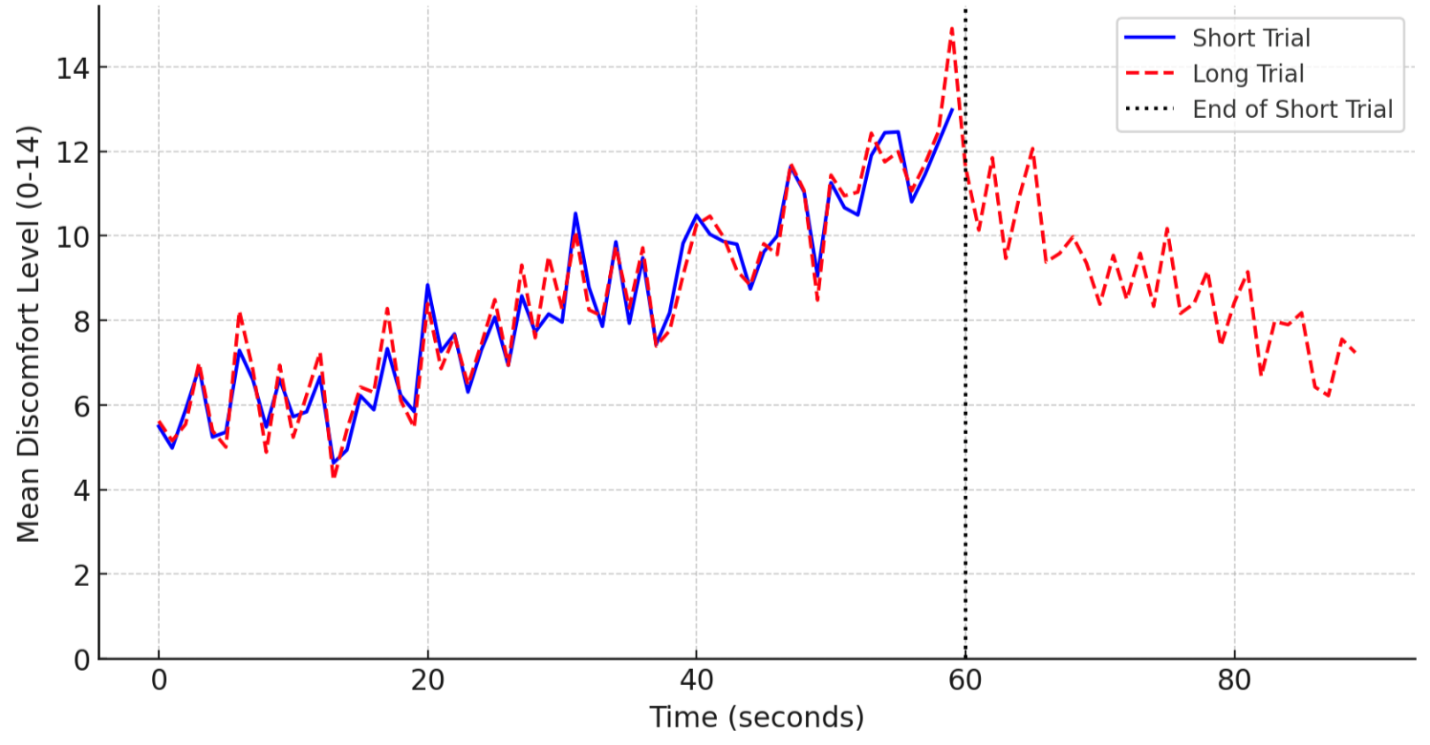
Discomfort generally increased with duration for both trials. However, over the last 30 seconds of the long trial, while the temperature was being raised, discomfort consistently decreased.
Approximately 58% (7/12) of the participants reported that they preferred the longer trial (Muller).
Discussion
There were two major differences between the short and long trials: duration and ending. Fifty-eight percent (7/12) of participants favored the long trial with a slightly less uncomfortable ending. The findings disagree with our hypothesis which predicted that a majority of participants would prefer the shorter experience of discomfort. Why might this be the case?
In the moment, participants experienced increasing discomfort as each trial progressed. But when they looked back on the two experiences, they remembered the long trial more positively. Their experiencing and remembering selves perceived the situation in nontrivially different manners.
Our hypothesis was incorrect because it failed to account for the differences in perception between the experiencing and remembering selves. The experiencing self acts to minimize discomfort. Here, the short trial imposed discomfort for the least amount of time. So, the experiencing self would have preferred the short trial, supporting our hypothesis. However, since participants were asked which experience they preferred after both trials, the remembering self was activated, (i.e. their memories of the two experiences, rather than their feelings during them, shaped their retrospective preference).
The remembering self does not characterize experiences by their length, an effect termed duration neglect. Rather, the memory of an experience is dominated by peak and end moments. Peak moments include those of highest emotional excitement, moments filled with intense joy, fear, anger, etc. End moments simply refer to the end of an experience. The feeling anchored to the ending of an experience plays a disproportionate role in how the entire experience is remembered, a phenomenon known as recency bias (Muller).
The concepts of experiencing versus remembering selves, duration neglect, peak moments, and recency bias provide an explanation for the findings of this study. The participants’ remembering selves characterized their experience of each trial using peak and end moments, largely disregarding duration. Both experiences had the same peak levels of discomfort. Consequently, their memory of each experience was determined by end moments. Since the longer experience of discomfort had a better ending than the shorter experience, people formed a more positive memory of it, leading them to prefer it.
This experiment was carried out with a sample size of 12 people. It would be beneficial to replicate it with a larger sample to corroborate the findings.
Conclusion
This study consisted of an experiment where participants were asked to rate their levels of discomfort in real-time during two trials, one short, the other long, in which they were required to submerge their hand in 14°C water for 60 seconds with an additional 30 seconds at 15°C for the longer trial. The long trial induced less discomfort at the end of the experience by slightly increasing the temperature, leading 58% of participants to prefer it. It was found that people’s perception of discomfort is independent of experience duration and largely determined by peak and end moments.
These findings imply that people can make better memories if they end experiences positively. They also have implications in the health and business sectors. Designing better ends to medical procedures and checkups can increase visits to the doctor’s office, ultimately improving long-term health outcomes. Selling cheap and delicious food after checkout stations at stores can cause customers to feel positive about their shopping experience and eager to come back again, a strategy exemplified by Costco and their famous ice cream. Adding a better end makes experiences positively remembered, a result that is powerful for both individuals and collectives.
This experiment suggests multiple avenues for further research. Three are mentioned here. First, variations of this experiment could be conducted to test the effect of changing the duration of less discomfort in the long trial. Is there a maximum length the less uncomfortable period can be before preference for it declines? Second, experiments can be designed to explore the relationship between peak and end moments. Here peak moments were held constant, while end moments varied. If end moments were kept constant, but peak moments varied, would the results change? What if both varied? Third, while this experiment primarily tested the remembering self’s perception, future experiments could investigate the experiencing self’s perception and/or differences between the perceptions of the two selves.
Works Cited
Ashkenazy, Shelly, and Freda DeKeyser Ganz. “The Differentiation Between Pain and Discomfort: A Concept Analysis of Discomfort.” Pain Management Nursing, vol. 20, no. 6, 2019, 556-562. doi:10.1016/j.pmn.2019.05.003.
Muller, Derek. “Why People Prefer More Pain.” YouTube, uploaded by Veritasium, 25 June 2024. https://youtu.be/v4r71kEdYME?si=H2sWpwC3hQD68XMb.
 Loading…

 Reload document
  Open in new tab
This entry is licensed under a Creative Commons Attribution-NonCommercial-ShareAlike 4.0 International license.

